

Using Google Books for Research
This strategy is applicable to all grade levels and all strands of social studies.
The Purpose:
- Deep Learning
- Research provides students the opportunity to explore subjects in-depth, and gives them skills in differentiating between reliable sources
- Higher Student Achievement
- These free resources are available at many levels for all students, and encourage self-guided discovery
- Student Engagement
- The variety of resources available inspires questions, investigation, and connections for critical thinking
- Well-Being
- Success in learning brings more success in learning and higher positive energy
Description:
Google Books is a resource that makes primary and secondary sources extremely accessible, and gives students opportunities to investigate and build their inquiry skills.
Google Books is available online at books.google.com or through the Google Play app, and includes over 10 million free books to read and download. Google Books also includes various primary source government and community organization documents. These resources can be viewed easily online or downloaded as PDFs to share with students.
Here are just a few of the primary sources you can find there:
- The original publication of Frederick Douglass’s autobiography, in his own words
- An Account of the Proceedings on the Trial of Susan B. Anthony, on the Charge of Voting at the Presidential Election in November 1872
- The Great Transcontinental Railroad Guide of 1870
- The New York Memorial dedicated at Antietam Battlefield
How to Set Up the Strategy
You do not need to be logged into Google to access these resources.
1. Visit books.google.com.
2. Enter your search in the search bar. The results listed will include full sources that are copyright-free and previews of books that still are copyrighted.
3. To find free resources, select “Free Google E-books” under the “Any books” dropdown menu.
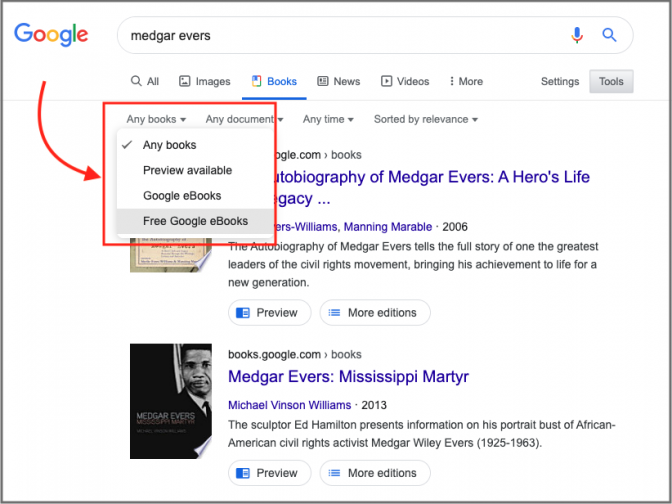
3. Teachers and students can download PDFs of these sources for research.
4. As they work, remind students to:
- Stay focused on the research.
- Keep track of references.
- Don’t be a distractor.
- Work independently or collaborate.
- Ask for help if needed.
5. As students use Google Books for research, they should learn to differentiate between secondary sources — which tell a story about an event or person — and primary sources, which come directly from that event or person.
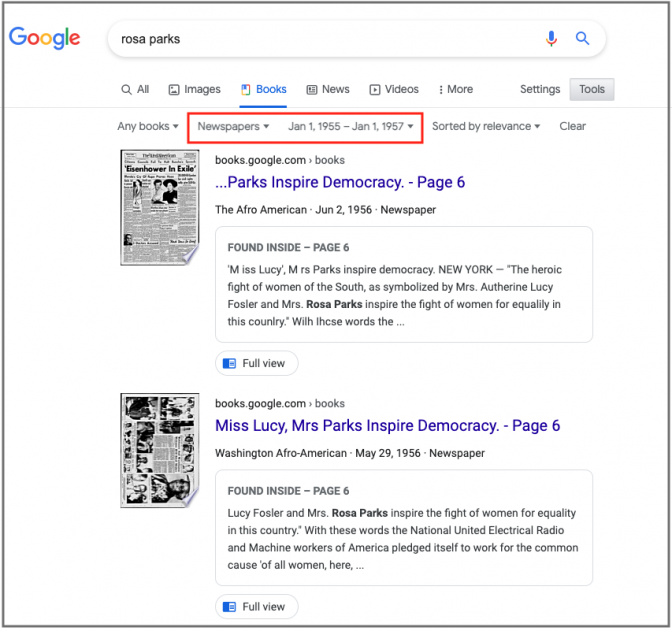
For example, there are many books on Rosa Parks on Google Books, but to find sources from during the time of the Montgomery Bus Boycott, you will have to narrow your search.
(See image example)
Digital/Virtual Application of this Strategy:
Google Books supports virtual learning by supplying digital resources for students to use. It gives teachers a bank of information they can vet for students to use, download, and distribute electronically.
Face-to-Face Application of this Strategy:
The great thing about Google Books is that they can be used both virtually and in the classroom. In a face-to-face scenario, the teacher has the opportunity to immediately supply support and be sure students are able to find what they need. Downloads can also be distributed this way.
Google Books can be saved in an online library when you log in to Google. You can use this library to create collections you can refer to later, so you don’t have to search for them again.
This strategy also can be used with most graphic organizers and interactive notebooks.
Social Studies
Standards-aligned lessons that spark curiosity
Studies Weekly Online
Less prep, more impact on students
Health & Wellness
Boost your students’ emotional wellness skills
Science
Encourage students to investigate through hands-on learning