

How Studies Weekly’s K-5 Alabama Science Hits Every Standard
Science should help students ask questions, explore ideas, and make sense of the world around them. That is why Studies Weekly created Alabama Explore Science for grades K–5.
Built to align with the 2023 Alabama Course of Study: Science, Alabama Explore Science helps teachers support discovery, scientific thinking, and standards-based instruction in one program.
In this article, you will see how the curriculum supports Alabama’s six science positioning statements and gives teachers practical tools for daily instruction.
What this article covers:
• Scientific literacy
• Nature of science
• Inquiry and collaboration
• Differentiation and accessibility
• Assessment and cross-curricular learning
• Lab and classroom safety
Position Statement 1
“Science classrooms in Alabama must create opportunities for students to develop scientific literacy.”
According to the Alabama Course of Study: Science, “A scientifically literate person understands what science is and how to use it to make decisions and take actions in everyday life.”
Scientific literacy means students can find reliable scientific information, evaluate it, understand important concepts, and apply what they learn in meaningful ways. Alabama Explore Science helps students build those skills through reading, writing, speaking, listening, inquiry, and hands-on learning.
The Course of Study also explains that students should use developmentally appropriate literacy skills in science, including reading scientific texts, recording observations and data, writing about their learning, and communicating ideas through discussion and presentation. Alabama Explore Science supports those expectations with grade-level, chunked text, scientific vocabulary, and lessons that connect Disciplinary Core Ideas, Science and Engineering Practices, Crosscutting Concepts, and supporting ELA and Math skills.
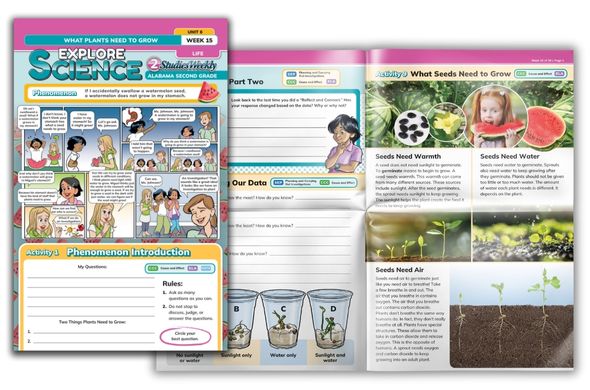
Because Studies Weekly is a consumable program, students can record observations, questions, procedures, hypotheses, and data directly in their student materials. In the sample lesson pictured above, students practice planning an investigation and documenting their thinking as they work through the activity.
Students also learn through partner work, small-group discussion, and whole-class conversations. As they explain their thinking and respond to others, they strengthen both scientific understanding and communication skills.
Position Statement 2
“Students must develop an understanding of the nature of science in order to become scientifically literate.”
Studies Weekly aligns to the Alabama Course of Study by addressing the foundational core principles of science. These principles stay constant across grade levels, even as concepts build on each other and grow in complexity. That is why they should be taught through clear instruction and reflective discussion.
Studies Weekly also addresses these Nature of Science (NOS) core principles alongside the three dimensions of the Next Generation Science Standards:
• Disciplinary Core Ideas (DCI)
• Science and Engineering Practices (SEP)
• Crosscutting Concepts (CCC)
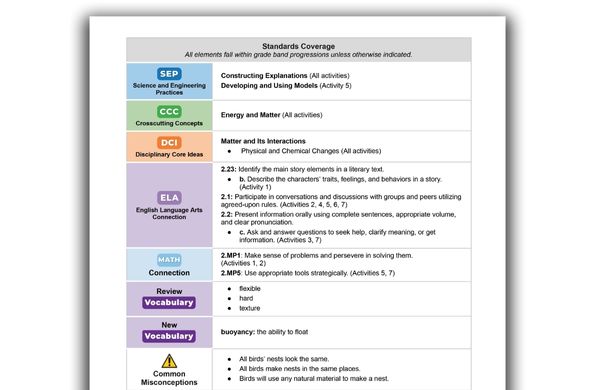
To support teachers, the Studies Weekly Teacher Editions clearly highlight where NOS, DCI, SEP, and CCC are covered in every unit of instruction (Fig. 2). This helps teachers quickly see alignment and feel confident that their Studies Weekly materials are meeting standards.
Position Statement 3
“All students should have opportunities to learn scientific information through inquiry and experience, using their individual funds of knowledge to enhance classroom instruction.”
Science is best taught, understood, and advanced not in a vacuum, but in collaboration and connection with a global science community. Every individual brings their own perspective and a unique personal fund of knowledge. Written in the Alabama Course of Study, “Valuing students’ individual funds of knowledge enhances teaching and learning in the science classroom. Educators should actively encourage students to share their science-related experiences in positive ways to promote sharing and collaboration in learning.”
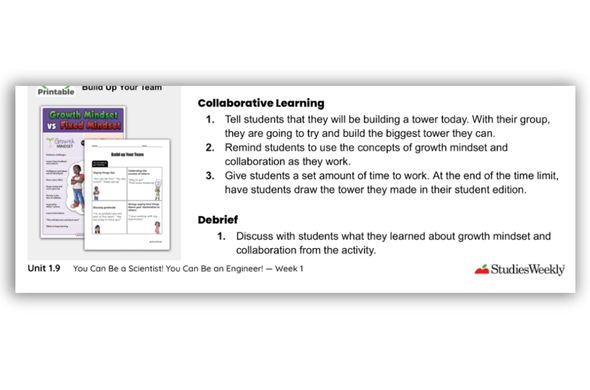
Studies Weekly includes many collaborative learning activities to encourage students to problem-solve together and draw from their individual knowledge in group settings. Teamwork allows students to share their ideas, perspectives, and knowledge, strengthening the classroom community and helping students learn from each other.
This sample lesson selection (Fig. 3) highlights a collaborative learning activity in which students use their prior knowledge and group critical thinking to build a tall tower.
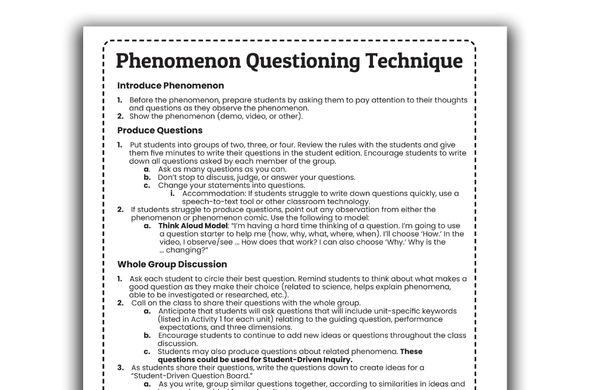
Studies Weekly encourages students to draw upon their individual knowledge, unique ideas, and personal perspectives through Guiding Questions and Phenomenon Questioning Techniques. After phenomena are introduced, students are instructed to ask as many questions as they can, drawing on their prior knowledge and what ideas come into their minds (Fig. 4). Not every student will think of the same questions, so sharing them with the class helps all students to learn from one another as they hear each other’s ideas.
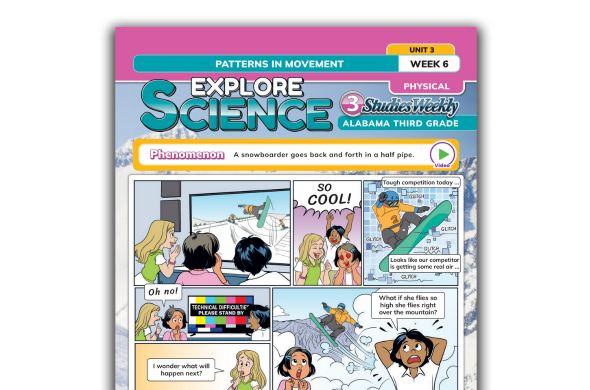
Additionally, the phenomena introduced in the Student Editions are purposefully designed to be relevant and familiar to students’ lives, maximizing their engagement and interest in learning. For example, in Grade 3 Week 6 (Fig. 5), students are introduced to movement and patterns through an engaging story about snowboarding.
Position Statement 4
“Providing differentiated instruction in the science classroom is essential for meeting the diverse needs of all students.”
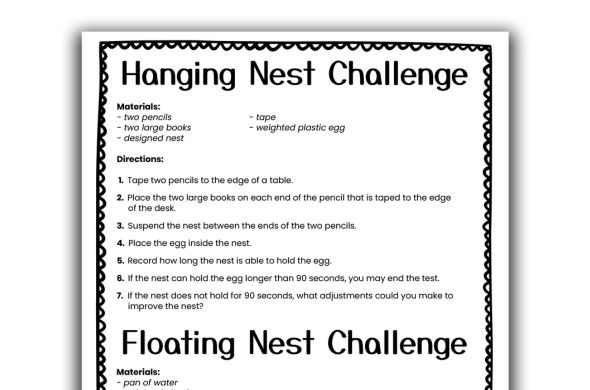
Differentiated instruction is an important practice to support student equity and success. To accommodate the needs of all learners, Studies Weekly Online equips teachers with resources to differentiate instruction at the group and student levels. The online platform contains accessibility supports, including a variable-speed, human-recorded audio reader, ADHD-focused reading panels, and other content adjustment options for individual student needs. The Teacher Edition also contains suggestions for differentiation and optional extension activities (Fig. 6) for each lesson, allowing teachers the flexibility to differentiate instruction without taking extra prep time.
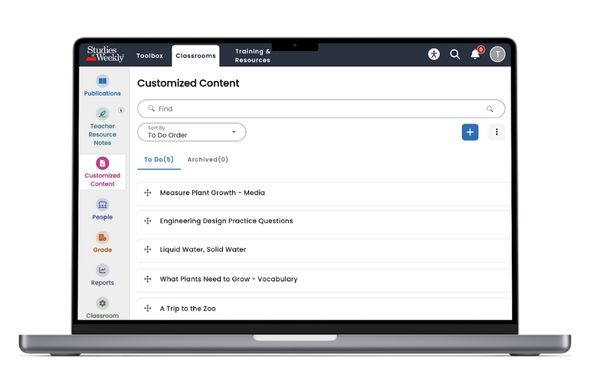
Within the online platform, teachers can customize online articles, activities, quizzes, assessments, and more according to their teaching styles and students’ needs. Customized content can be assigned to individual students or to the whole class, allowing teachers more control over the online learning experience (Fig. 7).
Position Statement 5
“High-quality teaching and learning in science require a collaborative classroom environment, an instructional design that promotes exploration, a variety of assessments, and opportunities to make cross-curricular connections.”
Studies Weekly’s Alabama Explore Science promotes hands-on, inquiry-based exploration in every unit of instruction — exploration is in the name! Students drive learning with their own questions, observations, and hypotheses. With opportunities to work independently or together, students learn to problem-solve and let curiosity and critical thinking drive their exploration.
The Alabama Course of Study designates criteria for scientific instructional design, including:
- Identifying the outcome from the standards
- Determining acceptable evidence of student learning
- Developing engaging activities and learning experiences based on the desired outcome
The Studies Weekly lesson plans in the Teacher Edition fill these criteria by delineating lesson objectives and basing activities on multiple research-based instructional models, including phenomenon-based instruction and the 5E model.
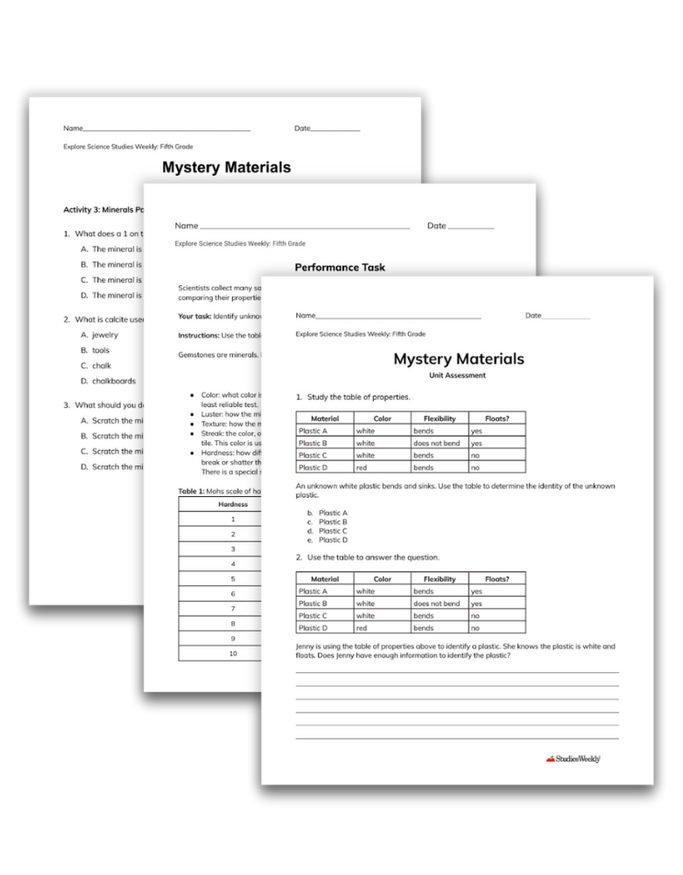
The Teacher Edition also includes printable and online formative and summative assessments, including unit assessments, reading comprehension assessments, and performance tasks (Fig. 8), to give students opportunities to show what they know and can do. Teachers can also easily access and monitor student performance through the online platform to identify opportunities for intervention and differentiation.
Because making cross-curricular connections strengthens learning and enhances comprehension, Studies Weekly integrates Math and ELA standards within its science curriculum. Students develop reading and writing skills by engaging with scientific texts, identifying evidence, making observations, and explaining their reasoning. Students also learn math skills by gathering, analyzing, and visualizing data. Because science impacts so many areas of life, Alabama Explore Science can be easily integrated into other disciplines to make teaching science more flexible for teachers and more comprehensive and holistic for students.
Position Statement 6
“In science classrooms and laboratories, safety must be prioritized to minimize risk in hands-on environments.”
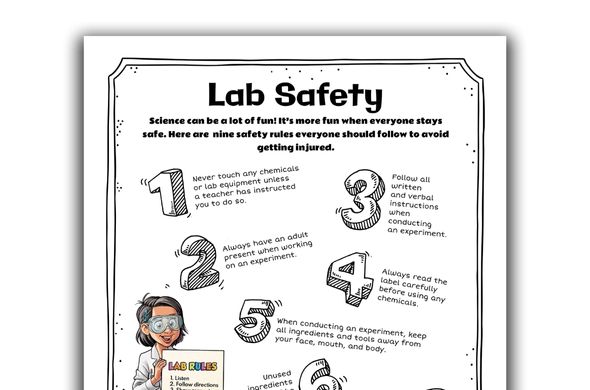
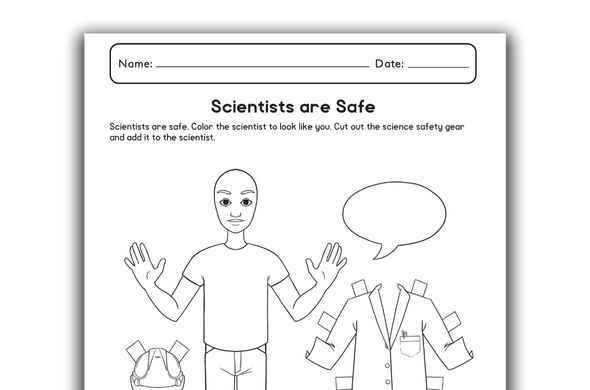
To help keep our teachers and young scientists safe, Studies Weekly’s Alabama Science curriculum emphasizes classroom safety practices before students begin experimenting. Lab safety lessons and activities help students recognize the importance of practicing care and responsibility in the science classroom.
In this grade 1 activity, students learn nine safety rules they should always follow when practicing science (Fig. 9).
In this activity, students learn the important role of lab safety gear in keeping them safe and protected (Fig. 10).
Alabama Explore Science is built to support strong science instruction across grades K–5. With standards-aligned lessons, hands-on learning, differentiation tools, assessments, and safety instruction, the program helps teachers meet Alabama’s science expectations while keeping students engaged in discovery.
K–5 Alabama Science
Encourage students to investigate through hands-on learning