

Here Are 12 Ways to Differentiate Instruction With Studies Weekly
Every classroom is filled with different learners. One student may read a passage independently and immediately want to discuss it. Another may need to hear the passage read aloud, talk through the vocabulary, or look at a photograph before the ideas begin to make sense. One student may love writing, while another may explain an idea beautifully through a drawing, discussion, or hands-on activity. And that’s okay!
That’s where differentiated instruction comes in. And here’s the good news:
Differentiation doesn’t have to mean creating a completely different lesson for every student.
Often, it’s about making small adjustments to the lesson you are already teaching so students have different ways to access the content, practice their learning, and demonstrate what they know. Studies Weekly materials offer lots of opportunities to do just that!
How to Differentiate Studies Weekly Materials
1. Start With a Learning Goal
Differentiation begins with knowing what you want students to learn. For example, if students are learning about patriotic symbols, your learning goal might be for students to identify important symbols and explain why they are meaningful. Differentiated instruction modifies the way students interact with the content, while still supporting the original learning goal.
In the patriotic symbols example, differentiation might look like studying photographs of patriotic symbols before tackling informational text. It might also look like a teacher-led vocabulary recap or a turn-and-talk before reading. Differentiating instruction is simply taking different pathways to help your students reach the same destination.
2. Use the Student Edition
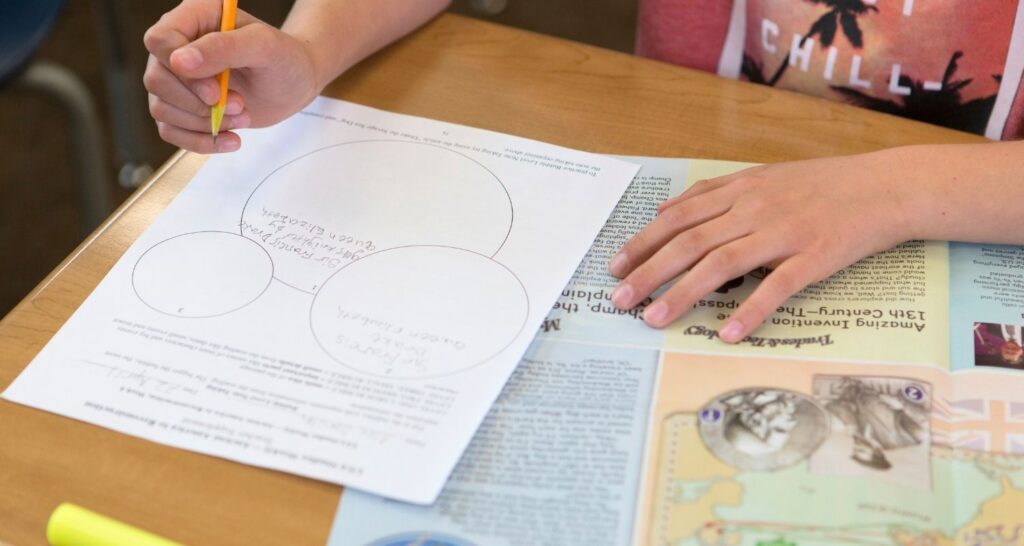
The consumable format of the Studies Weekly Student Edition gives students opportunities to interact with content in different ways. Try having students:
- Highlight important information
- Underline words that help them understand the topic
- Circle unfamiliar vocabulary
- Mark something that surprises them
- Write a question in the margin
- Identify a detail that supports the main idea
- Talk with a partner about what they read
For students who need additional support: consider reading a section together and stopping to discuss the photographs, captions, vocabulary, and main ideas.
For students who are ready for a challenge: ask them to find evidence in the publication that supports their thinking.
Remember: when you differentiate your instruction, you aren’t necessarily creating two different lessons. You’re giving students different levels of support while they work with the same content.
3. Let Visuals Do Some of the Teaching
Studies Weekly publications include photographs, illustrations, maps, charts, and other visuals that can become powerful differentiation tools.
For example, you could display a photograph before reading a related article and ask:
- What do you see?
- What do you think is going on?
- What do you wonder?
- What do you think this image can tell us?
Students who may struggle with the text can begin building background knowledge and vocabulary through the visual. Students who are ready for more can use the image as a primary source and make inferences about what was happening. A simple photograph can become an important entry point for every learner.
Tip: Studies Weekly has a “See, Think, Wonder” resource you can use as a pre-reading strategy, exactly like in the example above. You can find the printable located in the Training & Resources section of Studies Weekly Online.
Make Vocabulary More Accessible
Social studies comes with a lot of vocabulary! Words like constitution, representative, settlement, economy, and government can be challenging for young learners, especially when they encounter several new words at once.
Try pulling a few key vocabulary words from the week’s Studies Weekly publication and introducing them before students read.
You could:
- Create vocabulary cards
- Have students sketch the meaning of a word
- Act out the meaning of a word
- Connect a new word to something students already know
- Give students a sentence starter using the word
- Have partners explain the word to each other
During reading, invite students to highlight or circle vocabulary words in their Student Editions.
For students who need additional support: revisit new vocabulary words during small-group instruction.
For students who are ready for a challenge: ask them to use the vocabulary in a new context or writing activity in their Interactive Notebooks.

Use the Teacher Edition for Support
The Studies Weekly Teacher Edition can be a great resource for differentiation. Before teaching a lesson, look through the background information, vocabulary, instructional suggestions, activities, and assessment questions. Think about which parts of the lesson might require additional support and which students might benefit from an extension.
For example, if students are struggling to understand a historical concept, you might use the background information from your Teacher Edition to give them additional context before returning to the Student Edition.
You can also use the suggested activities for more ways to introduce and reinforce concepts. Sometimes the best differentiation is already sitting right there in your Teacher Edition!
6. Create Flexible Small Groups
Small-group instruction doesn’t have to happen every day or look the same every time. If, for example, you notice a group of students is struggling with the same vocabulary, you can pull those students together for a quick review while the rest of the class works on an independent activity.
Here is another way you might use multiple groups to differentiate instruction:
Group 1: Work with the teacher to read and discuss a section of the publication
Group 2: Work with a partner to find evidence in the text
Group 3: Complete an extension activity that requires deeper thinking
Group 4: Work independently to demonstrate understanding
Flexible groups allow you to respond to what students need, when they need it.

7. Give students choices
Sometimes students understand the content but have difficulty demonstrating their understanding through a traditional written assignment. When appropriate, give students choices.
After learning about a concept, a student might create an artifact, like a:
- Short biography
- Timeline
- Newspaper article
- Museum display
- Short presentation
- Comic strip
- Graphic organizer
Studies Weekly’s unique consumable format allows students many creative and hands-on opportunities to show what they know.
Here is an example of a graphic organizer that students can complete with their Studies Weekly Student Editions!
8. Get Hands-On
Hands-on activities can be especially helpful for students who benefit from learning by doing.
If you’re teaching geography, students might create a map with a scale and key. If you’re studying landforms, they could build and label a model.
You can also add layers of challenge in hands-on activities.
For example:
Beginning: Identify and label the parts of a map.
Developing: Explain what each part of the map helps us understand.
Extending: Use the map to answer a question, make a prediction, or explain a relationship between locations.
One activity can provide different levels of thinking without requiring you to prepare three completely different projects.
9. Use Compelling Questions
Compelling questions are another wonderful way to differentiate because students can enter the conversation at different levels. Instead of immediately asking students to recall information, start with a question that invites them to think.
For example: “Why do communities need rules?”
A student might answer based on personal experience. Another might connect the question to what they read in their Studies Weekly publication. Another might use evidence from history to develop a more complex response. You can then build on those responses as students move into the content.
Questions create opportunities for students to wonder, discuss, make connections, and develop their thinking, regardless of their reading or writing abilities.

10. Provide Scaffolds Without Lowering Expectations
Differentiation doesn’t mean lowering the learning goal. It means providing a bridge to help students reach it.
For example, if a student struggles with a passage, consider:
- Reading the first section together
- Breaking the text into smaller chunks
- Pre-teaching important vocabulary
- Using the photographs and captions to build background knowledge
- Providing sentence starters
- Asking guiding questions
- Allowing students to discuss their thinking
- Using a graphic organizer to organize ideas
The student is still engaging with important grade-level content. You’re simply providing the support needed to help them access it.
11. Challenge Students Who Are Ready for More
Differentiation isn’t only about helping students who are struggling. Some students are ready to take the learning further. If students quickly understand a concept, give them opportunities to:
- Find additional evidence in the publication
- Compare two historical perspectives
- Make connections to another topic they’ve studied
- Investigate a related question
- Explain why something happened instead of simply identifying what happened
- Create their own question about the topic
- Use what they’ve learned to solve a problem or make an argument
The goal isn’t simply to finish early. The goal is to think deeper.
12. Let Students Talk
One of the easiest differentiation strategies is also one of the simplest: give students time to talk!
Before asking students to respond to a question, have them turn to a partner. Try prompts such as:
- “Tell your partner one important thing you learned.”
- “What evidence did you find in the article?”
- “What surprised you?”
- “What questions do you still have?”
Students can rehearse their thinking out loud before putting it on paper. For students who need language support, this can be especially valuable. And even your strongest writers benefit from talking through their ideas before writing.
Differentiation Doesn't Have to Be Complicated
When we hear the words differentiated instruction, it can sometimes sound like one more thing to add to an already overflowing teacher plate. But it doesn’t have to be! Small changes can make a big difference.
You already know your students. You know their strengths, their struggles, their interests, and the moments when the lightbulb finally comes on. Use the resources you already have, watch how your students respond, and adjust when needed.
Differentiation isn’t about making teaching more complicated, but making learning more accessible, meaningful, and successful for every student in your classroom.
I would love to hear about ways you find success differentiating with your students.
Warmly,
Debbie

Debbie Bagley works as a Studies Weekly Teacher Advocate. Teacher Advocates are former teachers who help teachers like you implement Studies Weekly materials into their instruction. Teacher Advocates are available to provide support through email, phone call, and video chat. Teacher Advocates are only available for classroom teachers currently using Studies Weekly materials. They are not available for homeschools. Schedule a meeting with Debbie here.
Additional Resources
- Ways to Teach Kindness in February – Teacher Tips
- Supporting Texas Emergent Bilinguals with Translanguaging
- Try These 12 Play-Based Learning Activities – Studies Weekly
- Using Rubrics to Grade Open-Ended Questions – Studies Weekly
- Teaching Elementary Students About Vietnam War Veterans Day
- Thinking on Education: Teaching the History of Voting Rights